
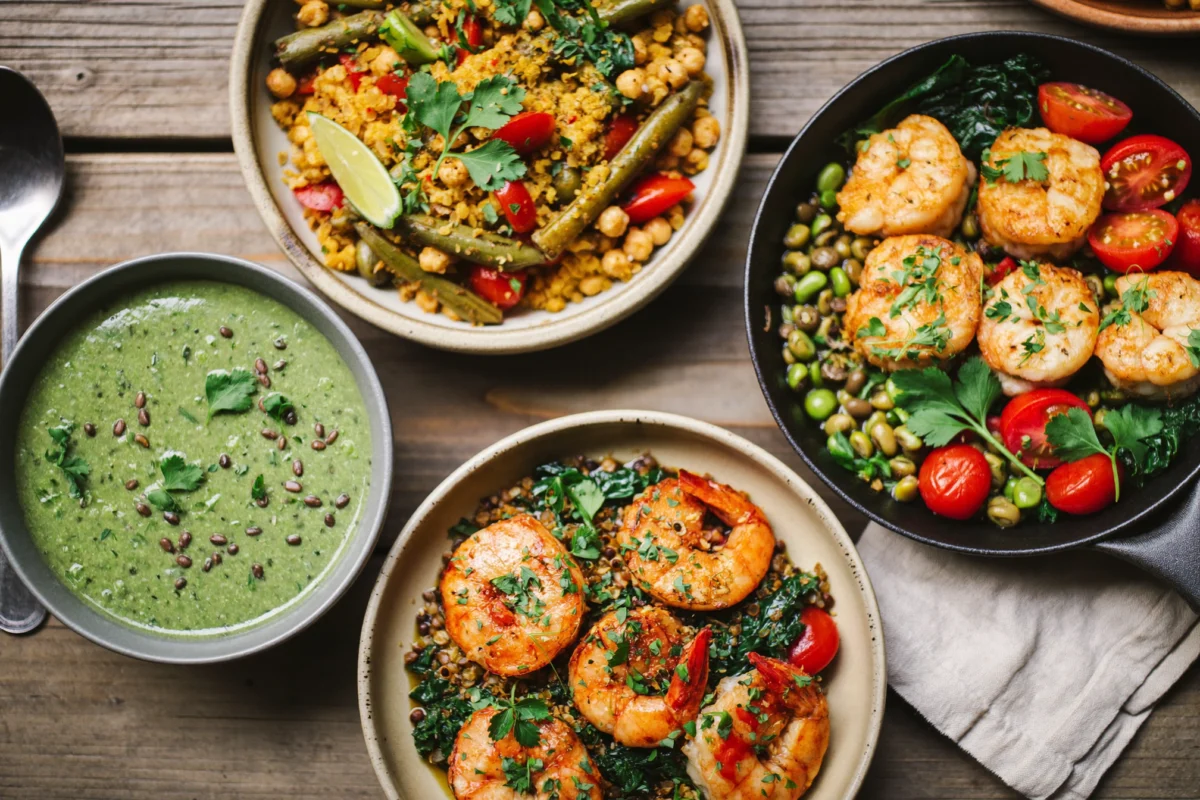
Moroccan couscous is still my favorite dish, and it shows what a filling plate looks like: grains, chickpeas, and vegetables together. I grew up around a full table with seven brothers and two sisters. I worked in restaurants, so food that truly feeds people matters to me. These high fiber recipes apply the same idea to everyday weight loss meals: seven easy dishes, each with an estimated 9 g of fiber or more and under 450 calories per serving.
Want a full week of meals like these?
The Healthy Weight-Loss Recipe Guide is free and includes 15 easy recipes, a 7-day meal plan, and a grocery list to make the week simpler.
Get the Free Guide →7 High Fiber Recipes Compared
These high fiber recipes cover breakfast, lunch, and dinner. All values are estimates per serving, so use the table to pick by time, meal, or how much fiber you are used to eating.
| Recipe | Fiber | Calories | Protein | Total time | Best for |
|---|---|---|---|---|---|
| Raspberry Almond Oatmeal with Flaxseed | 14 g | 310 | 10 g | 15 min | Breakfast |
| Moroccan Chickpea Vegetable Couscous | 11 g | 355 | 13 g | 45 min | Family dinner |
| Green Lentil Bulgur Tabbouleh | 10 g | 355 | 15 g | 40 min | Packed lunch |
| Garlic Shrimp with White Beans and Kale | 12 g | 410 | 38 g | 25 min | Fast dinner |
| Chicken and Barley Stew with Mushrooms | 9 g | 390 | 32 g | 70 min | Cold evenings |
| Whole-Wheat Pasta with Peas, Broccoli, and Lemon | 12 g | 435 | 20 g | 25 min | Pasta night |
| Split Pea and Vegetable Soup | 16 g | 315 | 16 g | 70 min | Batch cooking |
What Makes a Recipe High in Fiber?
There is no single definition for home cooking, which is why one website’s high fiber list starts at 5 g per serving and another’s at 10 g. US food labeling offers a useful yardstick: a packaged food can be called high in fiber when one serving supplies at least 20% of the 28 g Daily Value, or about 5.6 g.
For this list I set the bar higher, at 8 g or more per serving from whole foods, with no fiber powders and fewer than 500 calories. The goal is a meal that does real work toward your daily total. US dietary guidelines suggest 14 g of fiber for every 1,000 calories, which comes to 28 g on a 2,000-calorie diet, according to the Mayo Clinic chart of high-fiber foods. One serving here supplies roughly a third to more than half of that.
If you are wondering what is a good source of fiber, legumes lead the same chart: 1 cup of boiled split peas has about 16 g, and lentils 15.5 g, and black beans 15 g. Raspberries reach 8 g per cup, and whole-wheat spaghetti 6 g. That is why those ingredients carry most of the recipes below.
Do High Fiber Meals Help With Weight Loss?
They can help, but they are not a guarantee. Weight loss still depends on your overall eating pattern, and these meals are one tool for making that pattern easier to follow. High fiber meals for weight loss work best when they replace lower-fiber meals, not when they are added on top of your usual food.
The evidence points to appetite. A 2001 review in Nutrition Reviews found that most studies linked more fiber with greater fullness after meals and less hunger later. When people ate freely, an extra 14 g of fiber a day was associated on average with 10% lower calorie intake and about 1.9 kg (4 lb) of weight loss over 3.8 months. Those are averages from an older review that itself calls the subject controversial, so treat them as a reason to try, not a promised result.
This list puts fiber first. If you also want a set protein target at every meal, our guide to high protein high fiber meals is built around that goal.
Why These Meals Feel So Filling: The Kitchen Science
High fiber recipes behave differently in the pot, and that affects how they eat. Oats and barley contain soluble fiber called beta-glucan, which absorbs water and forms a thick gel. It is the reason oatmeal turns creamy and why the barley stew thickens without any flour or cream.
Legumes behave differently. Heat softens their cell walls and swells their starch, so split peas collapse into a soup that needs no blender. Acid slows that softening, which is why the split pea soup gets its lemon juice at the very end. Canned beans are already cooked, so the tomatoes and lemon in the shrimp skillet are not a problem.
Water matters too. Soups, stews, vegetables, and well-hydrated grains add volume to the plate, so a modest calorie count still looks and eats like a full meal.
How to Add Fiber Without Feeling Bloated
Going from a low-fiber diet to a 16 g bowl of soup in one day can backfire. Adding too much fiber too quickly can cause gas, cramping, bloating, and diarrhea, so Mayo Clinic suggests increasing gradually over a few weeks and drinking plenty of fluids. Here is one simple way to do that; adjust the pace to how you feel.
| Week | What to cook | What to watch |
|---|---|---|
| Week 1 | One recipe every other day, or a half portion with a salad | Gas and bloating; hold here if needed |
| Week 2 | One full serving most days | Drink water with each meal |
| Week 3 | Up to two recipes on some days | Stay near your daily fiber target |
If you have a digestive condition, have recently had abdominal surgery, or follow a diet prescribed by a clinician, ask your doctor or a registered dietitian before making a big change. This article is general information, not medical advice.
The 7 High Fiber Recipes
Each of these high fiber recipes has a card below with US and metric amounts, step-by-step instructions, and estimated nutrition for one serving.
1. Raspberry Almond Oatmeal with Flaxseed
| Preparation Time | Cook Time | Total Time | Servings |
|---|---|---|---|
| 5 minutes | 10 minutes | 15 minutes | 2 |
Raspberries are the secret here, adding even more fiber than the oats themselves. Stir the ground flaxseed in off the heat and give it two minutes, because it keeps absorbing liquid. Frozen berries work just as well as fresh and often cost less in winter.

Raspberry Almond Oatmeal with Flaxseed
Ingredients
Method
- Bring the water, almond milk, cinnamon, and salt to a gentle simmer in a small saucepan over medium heat.
- Stir in the oats and cook 5 to 7 minutes, stirring often, until thick and creamy.
- Take the pan off the heat. Stir in the flaxseed and half of the raspberries, then rest 2 minutes so the flax can thicken the oats.
- Divide between 2 bowls. Top with the remaining raspberries, the almonds, and the maple syrup.
Notes
2. Moroccan Chickpea Vegetable Couscous
| Preparation Time | Cook Time | Total Time | Servings |
|---|---|---|---|
| 15 minutes | 30 minutes | 45 minutes | 4 |
This is a weeknight take on a dish that is traditionally steamed over a slow-cooking stew. Whole-wheat couscous replaces refined couscous and needs only boiling water and five minutes. Cut the carrots and turnip thick, since they go in first and should stay intact.

Moroccan Chickpea Vegetable Couscous
Ingredients
Method
- Heat the olive oil in a large pot over medium heat. Cook the onion 5 minutes, until soft.
- Stir in the cumin, ginger, turmeric, cinnamon, and salt and cook 30 seconds, until fragrant.
- Add the carrots, turnip, tomatoes, and broth. Bring to a boil, then simmer, partly covered, 15 minutes.
- Add the zucchini and chickpeas and simmer 10 minutes, until a fork slides easily into the vegetables.
- Put the couscous in a heatproof bowl, pour the boiling water over it, cover, and rest 5 minutes. Fluff with a fork. If your package gives a different water ratio, follow the package.
- Divide the couscous among 4 plates, spoon the vegetables and broth on top, and finish with the cilantro.
Notes
3. Green Lentil Bulgur Tabbouleh

| Preparation Time | Cook Time | Total Time | Servings |
|---|---|---|---|
| 15 minutes | 25 minutes | 40 minutes | 4 |
Traditional tabbouleh is mostly herbs with a little grain. Adding green lentils turns it into a full lunch. Green lentils hold their shape, unlike red ones, and dressing them while warm helps them absorb the lemon and oil.
Green Lentil Bulgur Tabbouleh
Ingredients
Method
- Bring the lentils and water to a boil, then simmer 20 to 25 minutes, until tender but still holding their shape. Drain well.
- While the lentils cook, put the bulgur in a large bowl, pour the boiling water over it, cover, and rest 20 minutes. Drain any water that remains.
- Add the warm lentils to the bulgur with the olive oil, lemon juice, and salt. Toss and cool 10 minutes.
- Fold in the tomatoes, cucumber, parsley, mint, and scallions. Taste and adjust the salt and lemon.
Notes
4. Garlic Shrimp with White Beans and Kale

| Preparation Time | Cook Time | Total Time | Servings |
|---|---|---|---|
| 10 minutes | 15 minutes | 25 minutes | 4 |
This is one of the two fastest dinners on the list and the highest in protein. Cook the shrimp first and take them out early, because they turn rubbery if they simmer with the beans. Crushing a few beans thickens the broth without adding any cream.
Garlic Shrimp with White Beans and Kale
Ingredients
Method
- Pat the shrimp dry and season with the salt and pepper. Heat 1 tablespoon of oil in a large skillet over medium-high heat. Cook 1 to 2 minutes per side, until pink and opaque with an internal temperature of 145°F (63°C). Move to a plate.
- Lower the heat to medium. Add the remaining oil and the garlic and cook 30 seconds. Add the tomatoes and cook 3 minutes, until they begin to soften.
- Add the kale and broth, cover, and cook 3 to 4 minutes, until the kale is tender.
- Stir in the beans and simmer 3 minutes, lightly crushing a few with a spoon to thicken the broth.
- Return the shrimp to the skillet for 30 seconds to warm through, then stir in the lemon juice.
Notes
5. Chicken and Barley Stew with Mushrooms
| Preparation Time | Cook Time | Total Time | Servings |
|---|---|---|---|
| 15 minutes | 55 minutes | 70 minutes | 4 |
Pearl barley and peas supply most of the fiber, while chicken thighs stay tender through the long simmer. Let the mushrooms brown before adding the broth, since browning builds savory flavor through the Maillard reaction. Barley keeps absorbing liquid, so expect a thicker stew the next day.

Chicken and Barley Stew with Mushrooms
Ingredients
Method
- Season the chicken with the salt and pepper. Heat the oil in a large pot over medium-high heat and brown the chicken about 3 minutes per side. Move to a plate; it will finish cooking in the stew.
- Add the onion, carrots, celery, and mushrooms and cook 8 minutes, until the mushrooms release their liquid and begin to brown. Stir in the garlic and thyme for 30 seconds.
- Add the barley and broth and return the chicken to the pot. Bring to a boil, then cover and simmer gently 35 to 40 minutes, until the barley is plump and tender.
- Lift out the chicken and confirm the thickest piece has reached at least 165°F (74°C). Shred it with 2 forks and return it to the pot.
- Stir in the peas and simmer 3 minutes. Add a splash of water if the stew is too thick, then top with the parsley.
Notes
6. Whole-Wheat Pasta with Peas, Broccoli and Lemon

| Preparation Time | Cook Time | Total Time | Servings |
|---|---|---|---|
| 10 minutes | 15 minutes | 25 minutes | 4 |
Everything cooks in one pot of water, which saves dishes and keeps the broccoli bright. The starchy cooking water binds the oil, lemon, and parmesan into a light sauce. Portion size matters with pasta, so divide it evenly into four bowls.
Whole-Wheat Pasta with Peas, Broccoli and Lemon
Ingredients
Method
- Cook the penne in a large pot of boiling water according to the package. Add the broccoli for the last 4 minutes and the peas for the last minute.
- Scoop out 1 cup (240 ml) of the cooking water, then drain the pasta and vegetables.
- Heat the olive oil and garlic in the empty pot over medium-low heat for about 1 minute, without letting the garlic brown.
- Return the pasta and vegetables to the pot with the salt and 1/2 cup (120 ml) of the cooking water. Toss 1 minute until glossy, adding more water if needed.
- Take the pot off the heat and stir in the lemon zest, lemon juice, and parmesan.
Notes
7. Split Pea and Vegetable Soup
| Preparation Time | Cook Time | Total Time | Servings |
|---|---|---|---|
| 10 minutes | 60 minutes | 70 minutes | 4 |
This soup has the most fiber and nearly the fewest calories of the seven, so it is a good one to build up to. Dried split peas need no soaking, though older peas take longer to soften. It tastes even better after a night in the fridge.

Split Pea and Vegetable Soup
Ingredients
Method
- Heat the oil in a large pot over medium heat. Cook the onion, carrots, and celery 6 minutes, until soft.
- Stir in the garlic, smoked paprika, and thyme and cook 30 seconds.
- Add the split peas and broth. Bring to a boil, then simmer, partly covered, 50 minutes, stirring now and then, until the peas have collapsed. Older peas can take longer.
- Stir in the salt and spinach and cook 1 to 2 minutes. Add the lemon juice at the end and thin with water if needed.
Notes
Variations and Easy Swaps
- Gluten-free: Use quinoa instead of couscous, bulgur, or barley, and gluten-free pasta in recipe 6. Quinoa has less fiber, about 5 g per cooked cup, so the totals will drop. Choose certified gluten-free oats for the oatmeal.
- Vegan: Replace the parmesan with toasted almonds or nutritional yeast. Recipes 1, 2, 3, and 7 are already vegan as written.
- More protein: Add grilled chicken to the tabbouleh or an egg to the couscous. For more ideas, see our easy high protein low calorie meals.
- Different vegetables: Swap zucchini for butternut squash, kale for spinach, or broccoli for Brussels sprouts. Fiber and calories will shift a little.
- Dried beans: Replace each 15-oz can with about 1 1/2 cups (260 g) of home-cooked beans.
Meal Prep and Storage
Most of these high fiber recipes reheat well, so one cooking session can cover several lunches, and high fiber meals for weight loss are simpler to follow when they are already in the fridge. New to batch cooking? Start with our guide on how to start meal prepping. Refrigerate leftovers within 2 hours in shallow containers, and reheat them until steaming hot, to 165°F (74°C).
| Recipe | Fridge | Freezer | Reheating tip |
|---|---|---|---|
| Oatmeal | 3 to 4 days | Not recommended | Add a splash of milk or water |
| Couscous | 3 to 4 days | Stew only, 2 to 3 months | Store the couscous separately |
| Tabbouleh | 3 to 4 days | Not recommended | Serve cold; add the herbs late if prepping ahead |
| Shrimp skillet | 3 days | Not recommended | Warm gently so the shrimp stay tender |
| Barley stew | 3 to 4 days | 2 to 3 months | Add broth, as the barley thickens |
| Pasta | 3 to 4 days | Not recommended | Add a little water and extra lemon |
| Split pea soup | 3 to 4 days | 2 to 3 months | Thin with water or broth |
Common Mistakes and How to Fix Them
| Mistake | What happens | Fix |
|---|---|---|
| Adding lots of fiber at once | Gas, cramps, and bloating | Build up over a few weeks |
| Not drinking enough | Uncomfortable digestion | Drink fluids with every meal |
| Adding lemon early to split peas | Peas take longer to soften | Add acid at the end |
| Cooking the barley uncovered at a hard boil | Liquid evaporates and the pot may scorch | Cover and keep a gentle simmer |
| Overcooking lentils for tabbouleh | A mushy salad | Start tasting at 20 minutes |
| Simmering the shrimp with the beans | Rubbery shrimp | Sear first and return them at the end |
| Eating larger portions than planned | More calories than the table shows | Divide the batch before serving |
Estimated Nutrition per Serving
| Recipe | Calories | Fiber | Protein | Carbs | Fat |
|---|---|---|---|---|---|
| Oatmeal | 310 | 14 g | 10 g | 47 g | 11 g |
| Couscous | 355 | 11 g | 13 g | 62 g | 7 g |
| Tabbouleh | 355 | 10 g | 15 g | 54 g | 11 g |
| Shrimp skillet | 410 | 12 g | 38 g | 47 g | 8 g |
| Barley stew | 390 | 9 g | 32 g | 44 g | 9 g |
| Pasta | 435 | 12 g | 20 g | 67 g | 12 g |
| Split pea soup | 315 | 16 g | 16 g | 50 g | 6 g |
These numbers are estimates calculated from standard USDA ingredient values, rounded, and they have not been measured in a laboratory. Brands, portion sizes, and substitutions will change them, especially for broth, canned beans, and whole-wheat couscous.
Frequently Asked Questions
What food has the most fiber for weight loss?
No single food is best, but legumes are hard to beat. Split peas, lentils, and black beans each supply about 15 to 16 g per cooked cup, along with protein. Vegetables and berries add fiber for very few calories.
How can I get 30 g of fiber a day?
Combine a few fiber foods across the day. The oatmeal (14 g), the tabbouleh (10 g), and a medium pear (5.5 g) come to about 30 g. Work up to that level gradually if you currently eat much less.
Are high fiber recipes good for meal prep?
Yes, especially soups, stews, and grain salads. The split pea soup, barley stew, and couscous stew all freeze well. Grains keep absorbing liquid, so add a little water or broth when reheating.
Will these meals make me bloated?
They might at first if your current intake is low. Start with half portions, increase over a few weeks, and drink plenty of fluids. Rinsing canned beans also removes some of the liquid many people find harder to tolerate, as well as some sodium.
Are canned beans as good as dried?
For these recipes, yes. Canned beans still provide plenty of fiber and save a lot of time. Look for low-sodium cans when possible, and drain and rinse them before cooking.
Which of these recipes are gluten-free?
The shrimp skillet and split pea soup contain no gluten ingredients as written, and the oatmeal qualifies with certified gluten-free oats. Always check your broth label. The couscous, bulgur, barley, and pasta recipes need the swaps listed above.
Can I use a fiber supplement instead?
A supplement can add fiber, but it will not give you the protein, vitamins, and volume of a real meal. If you think you need one, ask your doctor or pharmacist first, because fiber supplements can affect how some medications are absorbed.
Ready to plan the rest of your week?
Download The Healthy Weight-Loss Recipe Guide for free: 15 easy recipes, a 7-day meal plan, and a grocery list you can take to the store.
Get the Free Guide →Start with One Recipe This Week
You do not need to change every meal to eat more fiber. Choose one dish from this list, cook it this week, and notice how long it keeps you full. High fiber recipes work best when they become regular meals you enjoy. If you need a starting point, the tabbouleh is a good lunch and the split pea soup is an easy batch to freeze.
