
Thirty grams of protein sounds simple until you try to build it on a plate. Two eggs and a slice of toast land around 16 grams. A salad with a few chickpeas barely reaches 10. The gap is rarely about effort. It comes down to knowing which good protein foods carry the most per serving and how to combine them. This guide walks through five steps for reaching 30 g per meal, with a focus on high fiber high protein foods like lentils, beans, and edamame that keep you full longer.
Why 30 g of Protein Per Meal Is a Useful Target
The official Recommended Dietary Allowance for adults is 0.8 grams of protein per kilogram of body weight per day (about 0.36 g per pound). Harvard Health notes that this figure is the minimum needed to avoid deficiency, not an ideal amount. People who exercise, are losing weight, or are older often aim higher.
Thirty grams per meal is a practical target many people use because it is easy to remember and easy to spread across three meals. It is not a medical requirement, and your own needs depend on your weight, age, and activity. If you have kidney disease or another health condition, check with your doctor before raising your protein intake. This article offers general nutrition information, not medical advice.
Protein alone is only half of the picture. The FDA daily value for fiber is 28 grams on a 2,000-calorie diet, and many adults fall short. Pairing protein with fiber slows digestion and helps meals feel more satisfying, which is why high fiber high protein foods are worth building your plate around.
Good Protein Foods: Protein and Fiber at a Glance
Values below are rounded estimates based on typical USDA FoodData Central entries. Brands, cuts, and cooking methods change the numbers, so check your own labels.
| Food (cooked unless noted) | Serving | Protein (approx.) | Fiber (approx.) |
|---|---|---|---|
| Chicken breast | 3 oz (85 g) | 26 g | 0 g |
| Salmon | 3 oz (85 g) | 21 g | 0 g |
| Eggs, large | 3 eggs | 18 g | 0 g |
| Cottage cheese, low-fat | 1 cup (225 g) | 28 g | 0 g |
| Plain nonfat Greek yogurt | 3/4 cup (170 g) | 17 g | 0 g |
| Firm tofu | 1/2 cup (125 g) | 20 g | 3 g |
| Lentils | 1 cup (200 g) | 18 g | 16 g |
| Edamame, shelled | 1 cup (155 g) | 18 g | 8 g |
| Black beans | 1 cup (170 g) | 15 g | 15 g |
| Chickpeas | 1 cup (165 g) | 14 g | 12 g |
| Quinoa | 1 cup (185 g) | 8 g | 5 g |
| Chia seeds | 1 oz / 2 tbsp (28 g) | 5 g | 10 g |
| Almonds | 1 oz (28 g) | 6 g | 3.5 g |
Notice the pattern. Animal foods and dairy deliver protein in a compact serving but no fiber. Legumes deliver both, though you need a larger portion to match the protein. Most strong meals combine the two groups.
How to Get 30g of Protein Per Meal in 5 Steps
Step 1: Pick Your Anchor Protein
Start with one food that supplies at least 20 grams: a palm-sized piece of chicken or salmon, a cup of cottage cheese, half a cup of firm tofu, or three eggs. Building around an anchor means the rest of the plate only has to cover the remaining 5 to 10 grams, which is far easier than collecting small amounts from five sources.
Step 2: Add a High Fiber Protein Partner
Next, add half a cup to one cup of lentils, beans, chickpeas, or edamame. These are the most useful high fiber high protein foods because a single serving contributes both nutrients. Half a cup of cooked lentils adds roughly 9 grams of protein and 8 grams of fiber to the plate.
If you eat plant-based, flip the order: let the legume or tofu be the anchor and use seeds, nuts, or quinoa as the partner.
Step 3: Do the Math Before You Eat
Add up the protein from your anchor and partner, then top up with small boosters if you are short. A tablespoon or two of chia seeds, a handful of almonds, or a sprinkle of hemp seeds each adds 3 to 6 grams. The table below shows combinations that reach about 30 grams.
| Combination | Protein (approx.) | Fiber (approx.) |
|---|---|---|
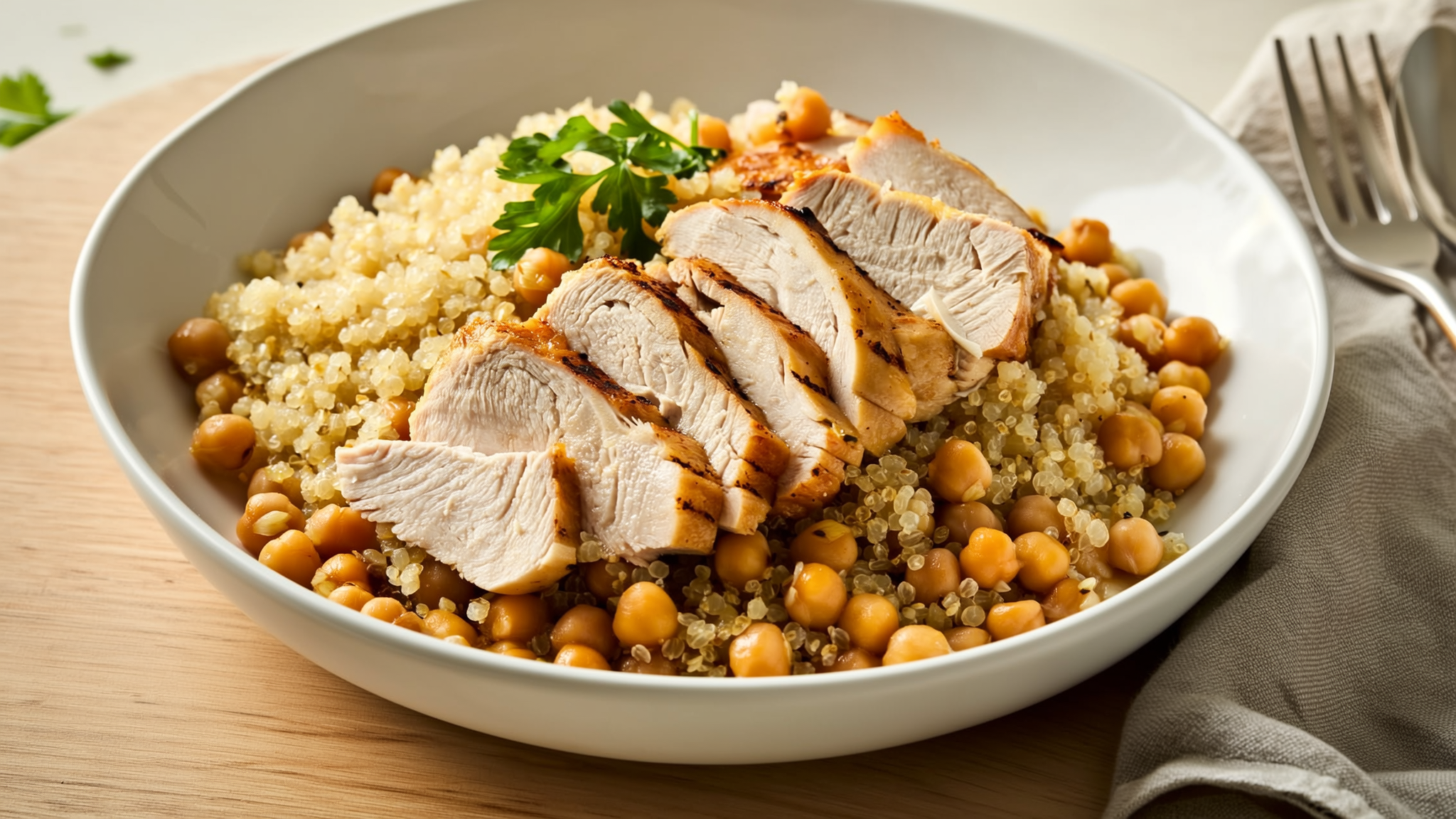
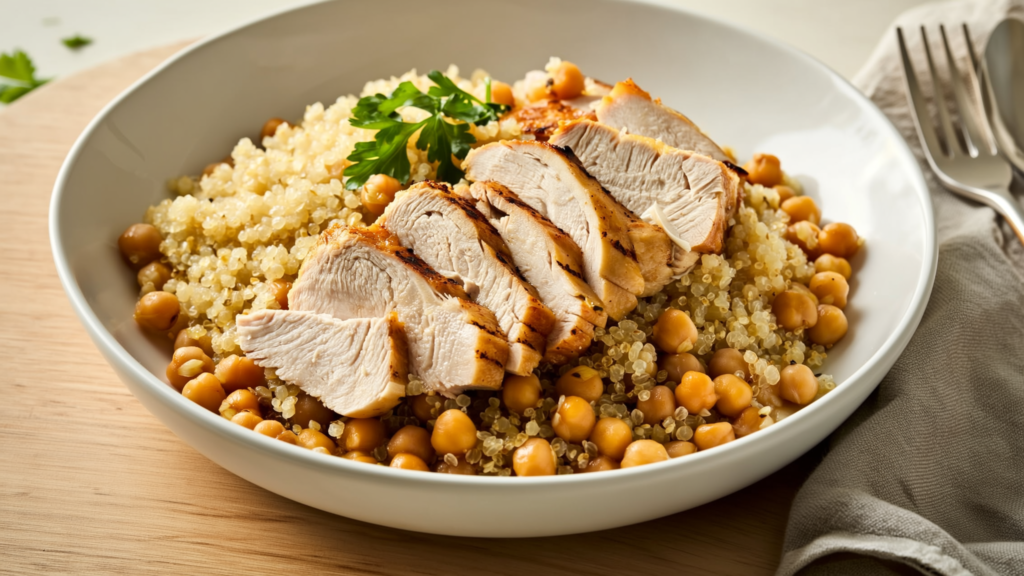
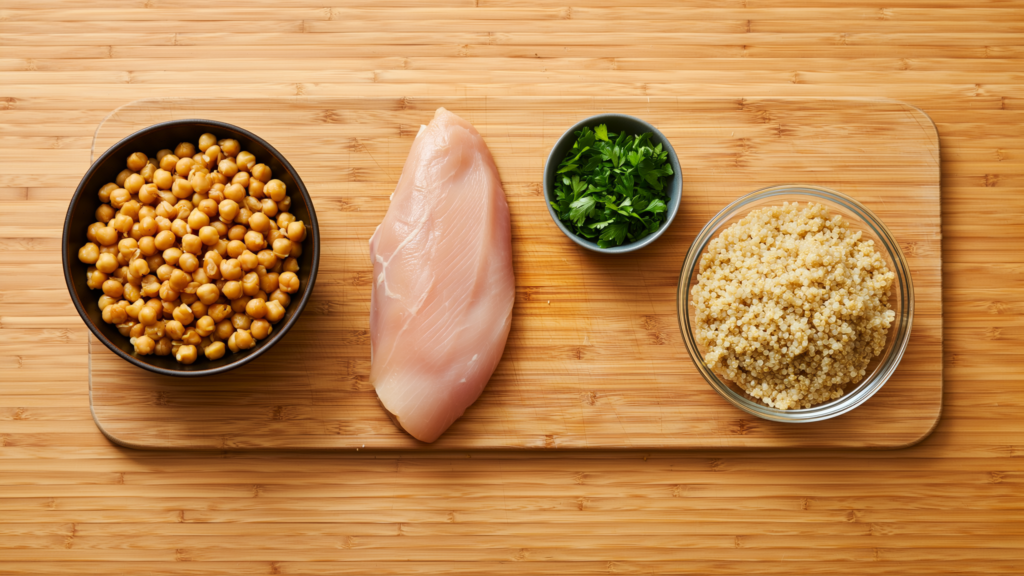
| 3 oz chicken breast + 1/2 cup chickpeas + 1/2 cup quinoa | 37 g | 9 g |
| 3 oz salmon + 1/2 cup chickpeas + 1/2 cup quinoa | 32 g | 9 g |
| 3 eggs + 3/4 cup black beans | 29 g | 11 g |
| 1/2 cup firm tofu + 1/2 cup lentils + 1/2 cup quinoa | 33 g | 13 g |
| 1 cup lentils + 3/4 cup shelled edamame | 32 g | 22 g |
| 3/4 cup cottage cheese + 2 tbsp chia + 1 oz almonds | 32 g | 13 g |
These are estimates built from rounded database values. They are meant to help you plan, not to replace a nutrition calculator if you track your intake closely.
Step 4: Cook Protein So It Stays Tender
Heat changes the structure of protein. As chicken or eggs cook, the protein strands unfold and tighten, which firms the texture. Push past that point and the strands squeeze out moisture, leaving dry chicken and rubbery eggs. Pull chicken from the heat as soon as it reaches an internal temperature of 165°F (74°C), use a thermometer rather than color, and let it rest for a few minutes before slicing.
For legumes, canned beans and lentils are a legitimate shortcut. Rinse them well to wash off excess sodium. Dried lentils need no soaking and usually cook in 20 to 25 minutes, so a big pot on Sunday covers several meals.
Step 5: Spread It Out and Prep Ahead
Eating 90 grams in one sitting is harder than three meals of 30 grams, and a protein-rich breakfast is often the meal people miss. Cook a batch of anchor protein and a batch of legumes at once, store them separately, and mix new combinations during the week. For ready-made ideas, our high protein high fiber meals collection and these quick chicken recipes give you full recipes to start from.
High Protein Foods & Meals
Ingredients
Method
- If your chicken is not already cooked, season it with salt and pepper and cook it in a skillet over medium heat until the internal temperature reaches 165°F (74°C). Use a thermometer rather than color. Rest the chicken for a few minutes, then slice it.
- Warm the chickpeas and quinoa together in a small pan or the microwave until steaming hot.
- Spoon the quinoa and chickpeas into a bowl and fan the sliced chicken on top.
- Drizzle with olive oil and lemon juice, sprinkle with parsley, and serve right away.
Notes
Easy Swaps and Variations
- Dairy-free: replace cottage cheese or Greek yogurt with firm tofu or edamame.
- Vegetarian: use eggs, tofu, and legumes as anchors and skip the chicken and salmon.
- Lower carb: keep the anchor protein and swap quinoa for extra vegetables. A cottage cheese pizza crust is one way to use dairy protein in a lower-carb meal.
- Canned fish: a 5 oz can of tuna packed in water gives roughly 25 grams of protein with no cooking.
Common Mistakes and Quick Fixes
| Mistake | Why it happens | Fix |
|---|---|---|
| Counting beans as a full protein serving | Legumes have protein, but a half cup gives only 7 to 9 g. | Use a full cup or pair beans with an anchor protein. |
| Skipping fiber when adding protein | Meat, eggs, and dairy contain no fiber. | Add legumes, vegetables, or chia to every plate. |
| Overcooking lean chicken | Lean cuts have little fat to protect moisture. | Cook to 165°F (74°C) and rest before slicing. |
| Raising fiber too quickly | A sudden jump can cause gas and bloating. | Increase legumes gradually and drink enough water. |
| Eating most protein at dinner | Breakfast and lunch are often light. | Aim for a similar amount at each meal. |
Storage and Reheating
| Food | Refrigerator | Notes |
|---|---|---|
| Cooked chicken or salmon | 3 to 4 days | Store in a sealed container; reheat until steaming hot. |
| Cooked lentils and beans | 3 to 5 days | Freeze in portions for longer storage. |
| Hard-boiled eggs | Up to 7 days | Keep in the shell until ready to eat. |
| Cottage cheese or yogurt | Check the label date. | Use clean spoons to avoid contamination. |
Reheat leftover cooked poultry to 165°F (74°C). Cool cooked foods quickly and refrigerate them within two hours.
Frequently Asked Questions
What are the best good protein foods for beginners?
Eggs, chicken breast, Greek yogurt, canned tuna, and lentils are inexpensive, easy to find, and need little cooking skill. Start with one anchor food and one legume per meal.
Which high fiber high protein foods give the most of both?
Lentils, black beans, chickpeas, and edamame lead the list. A cup of cooked lentils supplies about 18 grams of protein and 16 grams of fiber.
Is 30g of protein per meal necessary?
No. It is a convenient target, not a requirement. Your ideal amount depends on body weight, age, activity level, and health status, so a doctor or registered dietitian can give personal guidance.
Can I reach 30g of protein on a vegetarian diet?
Yes. Combine tofu, lentils, edamame, eggs, or dairy. One cup of lentils plus three-quarters of a cup of edamame reaches about 32 grams.
Do I need to eat complete proteins at every meal?
Not necessarily. Variety across the day usually covers your amino acid needs. Mixing legumes with grains, seeds, or dairy is a simple way to do it.
Can I meal prep these combinations?
Yes. Cook anchor proteins and legumes separately, refrigerate them, and assemble bowls through the week. Freeze extra lentils and beans in single-meal portions.
Final Thoughts
Reaching 30 grams of protein per meal is mostly arithmetic: one anchor protein, one fiber-rich partner, and a small booster if needed. Choose good protein foods you enjoy, lean on high fiber high protein foods like lentils and edamame, and plan a few combinations ahead. For nutrient data on specific foods, you can look them up in USDA FoodData Central.
