
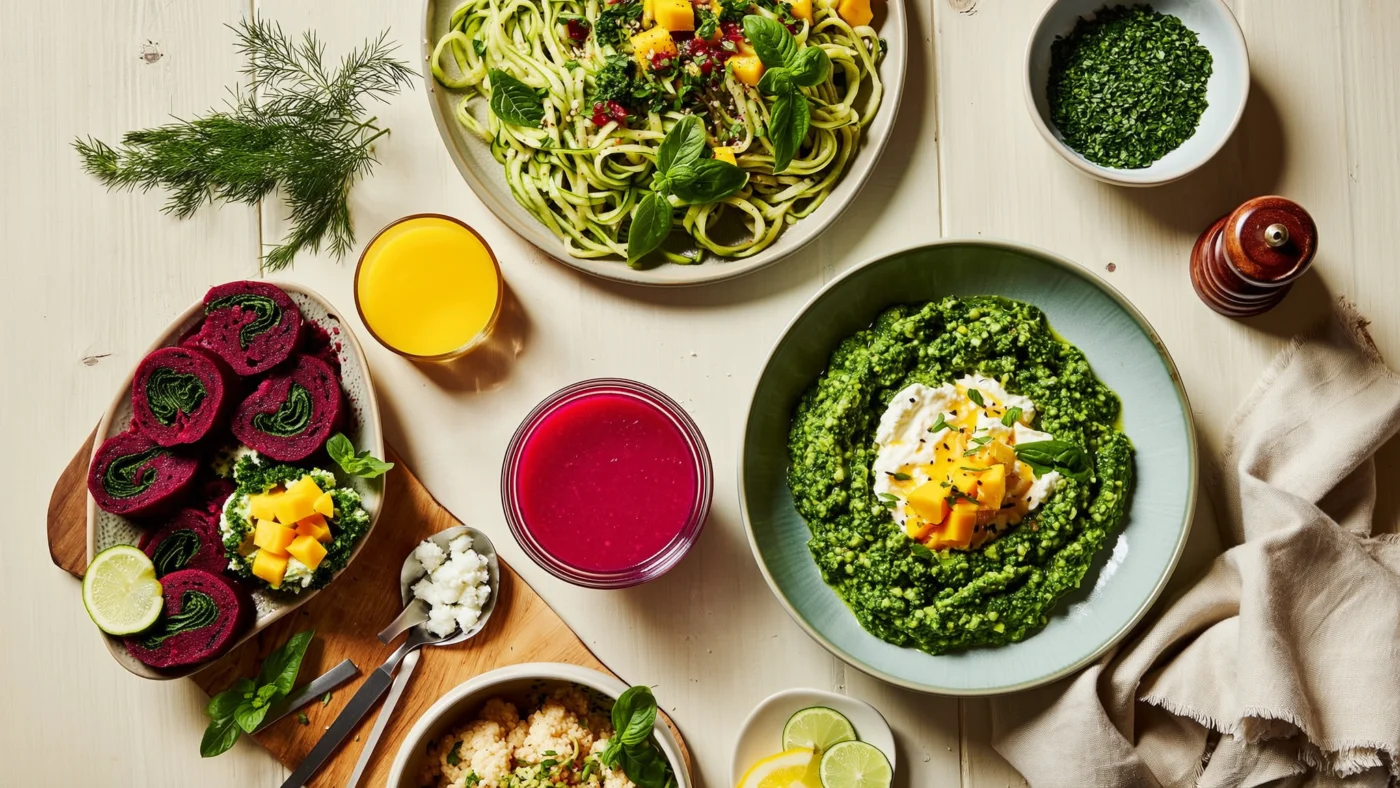
Raw cooking has a reputation for being a bowl of cold lettuce with good intentions. The real problem is usually technique, not the idea: zucchini that weeps into the sauce, dressings that taste flat, and nuts that stay gritty. Once you know what salt, soaking, and a strong blender actually do, uncooked food starts to taste finished. These vegetarian raw food recipes are built around those small fixes, and every one of them is also fully plant-based.
Why Raw Cuisine Recipes Often Disappoint (and How These Avoid It)
When people search for raw cuisine recipes, they usually want one of two things: a light meal that still feels satisfying or a way to use up produce without turning on the oven. Both are realistic, but only if the dish deals with three common problems.
- Too much water. Zucchini, tomatoes, and cucumbers release liquid as soon as they meet salt or acid. The recipes below either drain that water first or use it on purpose, as in the gazpacho.
- Not enough richness. Without cooking, there is no browning to build flavor. Nuts, seeds, avocado, tahini, and olive oil fill that gap.
- Tough or gritty texture. Soaking nuts, slicing paper-thin, and pulsing instead of pureeing make raw ingredients easier to eat.
If you would like the nutrition side of the story first, our guide to how raw food recipes can support your energy and overall health covers energy bliss balls, a zucchini pad thai, and a chocolate-avocado mousse, so none of those are repeated here.
The Simple Science Behind Raw Food Techniques
You do not need a food science degree to make these dishes, but three ideas explain most of the steps.
Osmosis. Zucchini is roughly 94 to 95 percent water. Salt pulls that moisture out of the cells, which is why salting spiralized zucchini for 10 to 15 minutes and squeezing it gently gives you noodles that hold a sauce instead of floating in a puddle. The same effect softens thinly sliced beets and helps the cauliflower in the tabbouleh absorb its dressing.
Emulsification. Oil and lemon juice do not mix on their own. Blending them with something that holds them together, such as soaked cashews or tahini, produces a creamy dressing that clings to vegetables rather than sliding off.
Soaking. Raw cashews are firm and starchy. A short soak in hot water softens them so a blender can turn them into a smooth cream, which is the base of both the pesto and the cheesecake cups.
Raw Food Safety: What to Do Before You Start
Because nothing here is cooked, produce handling matters more than usual. The FDA advises washing fresh produce under running water without soap, scrubbing firm items such as cucumbers with a clean produce brush, and keeping perishable produce in a refrigerator at 40°F (4°C) or below. You can read the full guidance on the FDA’s page on selecting and serving produce safely. Use a separate cutting board from any you use for raw meat, and wash beets and collard leaves especially well because they grow close to the soil.
7 Vegetarian Raw Food Recipes at a Glance
Every recipe is vegetarian and vegan, needs no oven and no dehydrator, and gives its own timing and serving count so you can plan around it. Cook time is zero for all of them; the extra minutes are soaking, resting or chilling.
| Recipe | Best for | Total time | Servings | Main tool |
|---|---|---|---|---|
| Zucchini noodles with basil-cashew pesto | Light main | 45 minutes | 2 | Spiralizer, blender |
| Raw cauliflower tabbouleh | Side or lunch | 40 minutes | 4 | Food processor |
| Chilled tomato-cucumber gazpacho | Starter | 1 hour 15 minutes | 4 | Blender |
| Collard wraps with walnut taco meat | Hand-held main | 25 minutes | 4 | Food processor |
| Beet carpaccio with lemon-tahini | Starter or side | 35 minutes | 4 | Mandoline or sharp knife |
| Mango-coconut chia pudding | Breakfast or snack | 4 hours 10 minutes | 2 | Blender |
| Raw lemon-cashew cheesecake cups | Dessert | 2 hours 55 minutes | 6 | Blender, food processor |
Vegetarian Raw Food Recipes to Make at Home
1. Zucchini Noodles with Raw Basil-Cashew Pesto

| Preparation Time | Cook Time | Total Time | Servings |
|---|---|---|---|
| 15 minutes (plus 30 minutes soaking) | 0 minutes (no cooking) | 45 minutes | 2 |
This is the dish that shows most clearly why technique matters in raw cooking. The zucchini gets a short salt rest so it stays crisp-tender, and the pesto uses soaked cashews in place of cheese for body. If you enjoy working with zucchini, these easy zucchini recipes are a good next step once you own a spiralizer.
Ingredients
- 2 medium zucchini (about 1 lb / 450 g)
- 1/2 teaspoon fine sea salt, divided (1/4 teaspoon for the zucchini, 1/4 teaspoon for the pesto)
- 1/2 cup (70 g) raw cashews
- 2 cups (about 40 g) packed fresh basil leaves
- 1 small garlic clove
- 2 tablespoons (30 ml) fresh lemon juice
- 2 tablespoons (30 ml) extra-virgin olive oil
- 3 to 4 tablespoons (45 to 60 ml) cold water
- 1/2 cup (75 g) cherry tomatoes, halved
Instructions
- Step 1: Cover the cashews with hot water and soak for 30 minutes, then drain well.
- Step 2: Spiralize the zucchini into a colander, toss with 1/4 teaspoon salt and leave for 10 minutes. Press gently with a clean kitchen towel to remove the liquid.
- Step 3: Blend the cashews, basil, garlic, lemon juice, olive oil, remaining 1/4 teaspoon salt and 3 tablespoons of water until creamy with a little texture left. Add the last tablespoon of water if it is too thick to pour from a spoon.
- Step 4: Toss the noodles with the pesto and tomatoes, and serve right away.
A useful trick here: soak the cashews for the pesto and the cheesecake cups (recipe 7) in the same bowl if you plan to make both.
2. Raw Cauliflower Tabbouleh

| Preparation Time | Cook Time | Total Time | Servings |
|---|---|---|---|
| 20 minutes | 0 minutes (no cooking) | 40 minutes (includes 20 minutes resting) | 4 |
Pulsed cauliflower stands in for bulgur, so there is nothing to boil or soak. Lemon and salt soften the grains while the parsley and mint keep everything bright. It works as a side, a lunch bowl or a filling for pita if you eat bread.
Ingredients
- 1 small head of cauliflower (about 1 lb / 450 g of florets)
- 2 cups (about 60 g) finely chopped flat-leaf parsley
- 1/4 cup (15 g) finely chopped fresh mint
- 2 medium tomatoes (about 10 oz / 280 g), seeded and diced
- 1 cucumber (about 8 oz / 225 g), seeded and diced
- 2 green onions, thinly sliced
- 3 tablespoons (45 ml) fresh lemon juice
- 3 tablespoons (45 ml) extra-virgin olive oil
- 1/2 teaspoon fine sea salt
Instructions
- Step 1: Pulse the cauliflower florets in a food processor, in two batches, with 5 to 8 short pulses until the pieces look like couscous. Stop before it turns pasty.
- Step 2: Toss the cauliflower with the lemon juice, olive oil, and salt in a large bowl. Let it rest for 20 minutes.
- Step 3: Add the parsley, mint, tomatoes, cucumber, and green onions. Toss, then taste and add more lemon or salt if needed.
Seeding the tomatoes and cucumber is worth the extra minute. It keeps the salad from turning watery in the fridge.
3. Chilled Raw Tomato and Cucumber Gazpacho

| Preparation Time | Cook Time | Total Time | Servings |
|---|---|---|---|
| 15 minutes | 0 minutes (no cooking) | 1 hour 15 minutes (includes 1 hour chilling) | 4 |
Gazpacho is the one dish here where the vegetable water is a feature. Ripe tomatoes do most of the work, so this is a recipe for summer produce rather than pale winter tomatoes. This version leaves out the bread that some traditional versions use.
Ingredients
- 2 lb (900 g) ripe tomatoes, cored and roughly chopped
- 1 cucumber (about 8 oz / 225 g), peeled and chopped
- 1 red bell pepper (about 6 oz / 170 g), seeded and chopped
- 1 small garlic clove
- 2 tablespoons (30 ml) extra-virgin olive oil
- 2 tablespoons (30 ml) red wine vinegar
- 1/2 teaspoon fine sea salt, plus more to taste
- Freshly ground black pepper
- Up to 1/4 cup (60 ml) cold water, if needed
Instructions
- Step 1: Blend the tomatoes, cucumber, bell pepper, and garlic until completely smooth, working in two batches if your blender is small.
- Step 2: With the blender running on low, add the olive oil in a thin stream so it blends in rather than floating on top. Add the vinegar, salt, and pepper.
- Step 3: Chill for at least 1 hour. Taste again before serving, because cold dulls seasoning, and add salt or vinegar as needed. Thin with a splash of cold water if it is thicker than you like.
The recipe makes about 4 cups (950 ml). Serve in small bowls with a little diced cucumber and a drizzle of olive oil.
4. Collard Wraps with Walnut Taco Meat

| Preparation Time | Cook Time | Total Time | Servings |
|---|---|---|---|
| 25 minutes | 0 minutes (no cooking) | 25 minutes | 4 (2 wraps each) |
Collard leaves are sturdy enough to hold a generous filling without tearing, which makes them one of the best raw wrappers. Pulsed walnuts and spices give a crumbly, savory filling with a taco-style flavor.
Walnut taco meat
- 1 1/2 cups (150 g) raw walnuts
- 1 tablespoon (15 ml) tamari or coconut aminos
- 1 tablespoon (15 ml) fresh lime juice
- 1 teaspoon ground cumin
- 1 teaspoon smoked paprika
- 1/2 teaspoon chili powder
- 1/2 teaspoon garlic powder
- 1/4 teaspoon fine sea salt
Wraps
- 8 large collard leaves
- 1 large ripe avocado, sliced
- 1 cup (150 g) diced tomato
- 1 cup (70 g) finely shredded red cabbage
- 1/4 cup (15 g) chopped fresh cilantro
- Lime wedges, to serve
Instructions
- Step 1: Wash the collard leaves well and pat dry. Trim off the tough stem, then shave the thick center rib flat with a knife so the leaf bends easily.
- Step 2: Pulse the walnuts with the tamari, lime juice, spices, and salt 8 to 10 times until the texture looks like coarse ground meat. Stop before it becomes a paste.
- Step 3: Lay a leaf flat, spoon 2 to 3 tablespoons of walnut mixture along the center, and top with avocado, tomato, cabbage, and cilantro.
- Step 4: Fold in the sides and roll up like a burrito. Serve with lime wedges.
Strict raw-food followers sometimes avoid tamari because it is fermented and heat-processed. Coconut aminos or an extra pinch of salt with more lime juice are easy swaps.
5. Beet Carpaccio with Lemon-Tahini Drizzle

| Preparation Time | Cook Time | Total Time | Servings |
|---|---|---|---|
| 20 minutes | 0 minutes (no cooking) | 35 minutes (includes 15 minutes marinating) | 4 |
Raw beets are crisp and earthy, and slicing them paper-thin changes them completely. A short rest in lemon and salt softens the slices, and the tahini sauce adds the creaminess they need.
Ingredients
- 3 medium beets (about 1 lb / 450 g), scrubbed and peeled
- 3 tablespoons (45 ml) fresh lemon juice, divided (1 tablespoon for the beets, 2 for the sauce)
- 1/2 teaspoon fine sea salt, divided
- 2 tablespoons (30 g) tahini
- 1 to 2 tablespoons (15 to 30 ml) cold water
- 1 small garlic clove, finely grated
- 2 tablespoons (18 g) raw pumpkin seeds
- 2 tablespoons (8 g) chopped fresh dill or parsley
- 1 tablespoon (15 ml) extra-virgin olive oil
Instructions
- Step 1: Slice the beets as thinly as you can with a mandoline or a very sharp knife. Toss with 1 tablespoon lemon juice and 1/4 teaspoon salt, then leave for 15 minutes.
- Step 2: Whisk the tahini with the remaining 2 tablespoons lemon juice, the garlic and the remaining 1/4 teaspoon salt. It will thicken at first, then loosen as you whisk in the water, one tablespoon at a time, until it is pourable.
- Step 3: Arrange the slices in overlapping layers on a platter. Drizzle with the tahini sauce and olive oil, then scatter the pumpkin seeds and herbs on top.
Disposable gloves keep beet juice off your hands, and a cutting board you do not mind staining helps too.
6. Mango-Coconut Chia Pudding

| Preparation Time | Cook Time | Total Time | Servings |
|---|---|---|---|
| 10 minutes | 0 minutes (no cooking) | 4 hours 10 minutes (includes 4 hours chilling) | 2 |
Chia seeds soak up liquid and form a soft gel, so the pudding needs no thickener or heat. Blending part of the mango into the milk gives the whole pudding fruit flavor, not just the topping.
Ingredients
- 3/4 cup (125 g) ripe mango, diced, for blending
- 1 cup (240 ml) unsweetened coconut milk (the drinking kind from a carton)
- 1 tablespoon (15 ml) maple syrup, or 1 pitted Medjool date
- Pinch of fine sea salt
- 1/3 cup (55 g) chia seeds
- 1/4 cup (40 g) diced mango, for topping
- 1 tablespoon (6 g) unsweetened shredded coconut
Instructions
- Step 1: Blend the 3/4 cup mango, coconut milk, maple syrup and salt until smooth.
- Step 2: Pour into a jar or bowl, whisk in the chia seeds, and wait 10 minutes. Whisk again to break up any clumps.
- Step 3: Cover and refrigerate for at least 4 hours or overnight.
- Step 4: Stir, divide between two glasses, and top with the diced mango and shredded coconut.
7. Raw Lemon-Cashew Cheesecake Cups

| Preparation Time | Cook Time | Total Time | Servings |
|---|---|---|---|
| 25 minutes (plus 30 minutes soaking) | 0 minutes (no cooking) | 2 hours 55 minutes (includes 2 hours freezing) | 6 |
This dessert is the richest recipe in the article, and a small cup is plenty. The crust is just almonds and dates, and the filling is a blended cashew cream that firms up in the freezer.
Crust
- 3/4 cup (85 g) raw almonds
- 4 Medjool dates (about 80 g), pitted
- Pinch of fine sea salt
Filling
- 1 cup (140 g) raw cashews, soaked in hot water for 30 minutes and drained
- 1/4 cup (60 ml) fresh lemon juice
- 1/4 cup (60 ml) maple syrup
- 1/4 cup (60 ml) coconut oil, melted until just liquid
- 1/4 cup (60 ml) water
- 1 teaspoon vanilla extract
- 1 teaspoon lemon zest
- Pinch of fine sea salt
- Fresh berries, to serve (optional)
Instructions
- Step 1: Pulse the almonds, dates and salt in a food processor until the mixture sticks together when pressed. Divide among 6 small cups or ramekins (about 4 oz / 120 ml each) and press down firmly.
- Step 2: Blend the cashews, lemon juice, maple syrup, melted coconut oil, water, vanilla, zest and salt for 2 to 3 minutes, scraping down the sides, until completely smooth.
- Step 3: Spoon the filling over the crusts and smooth the tops. Freeze for about 2 hours, until firm.
- Step 4: Let the cups sit at room temperature for about 10 minutes before serving, and top with berries if you like.
The coconut oil only needs to be liquid, not hot. If it is too warm, the filling can loosen, and if it is too cold it can form tiny solid flecks when it hits the cold cashew mixture.
Nutrition at a Glance
These notes describe what each dish is generally good for rather than exact numbers, because calories and macros change with brands, ingredient sizes and portion choices. For precise values, enter your own ingredients into a nutrition calculator.
| Recipe | Main nutritional strengths |
|---|---|
| Zucchini noodles with pesto | Healthy fats from cashews and olive oil, plus vegetables |
| Cauliflower tabbouleh | Fiber and vitamin C from tomatoes, parsley and lemon |
| Gazpacho | Mostly vegetables and water, a light starter |
| Collard wraps | Plant fats and some protein from walnuts, with fiber from the leaves |
| Beet carpaccio | Fiber and folate from beets, with fats from tahini and seeds |
| Chia pudding | Fiber from chia, vitamin C from mango |
| Cheesecake cups | A dessert: fats from nuts and coconut oil, sweetened with maple syrup and dates |
Variations and Smart Swaps
- Nut-free pesto and taco meat: Raw sunflower seeds can replace cashews in the pesto and walnuts in the taco meat. Soak the seeds for 30 minutes first and check labels if allergies are a concern.
- No spiralizer: Use a vegetable peeler to cut wide zucchini ribbons, or a julienne peeler for thin strands.
- Strictly raw sweeteners: Maple syrup is boiled during production, so strict raw-food followers can use blended Medjool dates or date paste instead.
- Gluten-free: These dishes are naturally gluten-free as long as your tamari is certified so, or you use coconut aminos. For more plant-based options that include cooked dishes, see these gluten-free vegan recipes.
- Heartier meal: Serve the tabbouleh or beet carpaccio with the walnut taco meat to turn a side into a full plate.
Storage Guide for Raw Dishes
These are conservative guidelines rather than lab-tested shelf lives. Keep everything at 40°F (4°C) or below, and discard anything that smells off or looks slimy.
| Recipe | Fridge | Notes |
|---|---|---|
| Pesto (without noodles) | Up to 3 days | Press plastic wrap onto the surface to limit browning |
| Salted zucchini noodles | Up to 1 day | Store dry and sauce just before eating |
| Cauliflower tabbouleh | Up to 2 days | Drain off any liquid before serving |
| Gazpacho | Up to 3 days | Stir and re-season before serving |
| Walnut taco meat | Up to 3 days | Assemble wraps just before eating so the leaves stay crisp |
| Beet carpaccio | Up to 1 day dressed | Store sliced beets and sauce separately for 2 days |
| Chia pudding | Up to 4 days | Add fresh fruit topping when serving |
| Cheesecake cups | Freezer, up to 1 month | Cover once frozen to protect from freezer odors |
Common Mistakes with Raw Cuisine Recipes
| Mistake | Why it happens | Fix |
|---|---|---|
| Watery zucchini noodles | Zucchini is mostly water and was not salted first | Salt for 10 to 15 minutes, then squeeze gently and dress just before eating |
| Gritty pesto or cheesecake filling | Cashews were not soaked or blended long enough | Soak for 30 minutes in hot water and blend for 2 to 3 minutes, scraping the sides |
| Mushy tabbouleh | Cauliflower was over-processed | Use short pulses and stop when it looks like couscous |
| Bland gazpacho | Underripe tomatoes, or cold dulls seasoning | Use very ripe tomatoes and re-season after chilling |
| Clumpy chia pudding | Seeds settled together at the bottom | Whisk again after 10 minutes |
| Grainy tahini sauce | Tahini tightens when it first meets lemon juice | Keep whisking and add water gradually until it loosens |
Frequently Asked Questions About Vegetarian Raw Food Recipes
Are vegetarian raw food recipes filling enough for a full meal?
They can be, if the plate includes some fat and protein-rich ingredients such as nuts, seeds or avocado. The collard wraps and the pesto noodles are the most meal-like options here. If you plan to eat mostly raw food over a long period, a registered dietitian can help you check that your overall diet is balanced.
Do I need a dehydrator for raw cuisine recipes?
No. Every recipe here uses a blender, a food processor, a knife or a spiralizer. Dehydrators are only needed for items like crackers and breads, which are not in this list.
Can I prepare these dishes ahead of time?
Yes, and some improve with time. The gazpacho, chia pudding and cheesecake cups are designed to be made ahead. For the zucchini noodles, wraps and beet carpaccio, prepare the components in advance and assemble just before serving.
Is tamari raw?
Not strictly. Tamari is fermented and heat-processed, so people who follow a strict raw diet often use coconut aminos or just salt and lime juice instead.
Why is my zucchini pasta still watery?
Check three things: the zucchini was salted for at least 10 minutes, it was squeezed in a towel afterwards, and it was only tossed with the sauce right before serving. Very large zucchini also hold more water and seeds, so medium ones work better.
Can I make the cheesecake cups nut-free?
I would not recommend forcing a substitute. Cashews give the filling its creamy, sliceable texture. For a nut-free dessert, the chia pudding is the better choice.
How do I keep gazpacho from tasting flat?
Use very ripe tomatoes, then taste after the soup is fully chilled. A pinch more salt or a small splash of vinegar usually brings it back into balance.
Final Thoughts on Raw Cuisine Recipes at Home
Good vegetarian raw food recipes are less about restriction and more about small techniques: salting, soaking, slicing thinly and balancing acid with fat. Start with the pesto noodles or the tabbouleh if you want a gentle introduction, and keep the cheesecake cups for when you want something special. For more meatless ideas beyond raw cooking, browse our vegetarian and vegan recipes.
